How to Make a Beaded Wrap Bracelet

A wrap bracelet is one long, narrow piece that circles the wrist several times. It can be a loomed band, beads lashed between two leather cords, or beads strung on memory wire. All three need the same first answer: how long.
This guide covers length, the three methods and their closures. It draws on bead shops’ wrap tutorials, a jewellery maker’s size guide, and the work of Erin Simonetti, the bead loom artist whose work this site shows. Erin made one loomed wrap: a long band she called the "list", on a Christmas cuff.
How long to make it
Start from your wrist; the bracelet size chart explains how to measure. Then multiply by the number of wraps.

Published sizes agree. Trollbeads lists double leather wraps of 14.2, 16.1 and 17.7 inches including a lock of about 0.78 inch; for a wrist up to 6.7 inches, that is twice the wrist plus the lock. Happy Hour Projects aims for a finished beaded length of about 20 to 22 inches for three wraps.
Erin’s band was woven to over 21 inches. It wraps three times, or twice around the wrist and once between the thumb, then fastens to a toggle on the cuff. Each wrap sits a little higher on the arm, and she allowed for that:
To allow for the space of wrapping the ‘List’, I made the cuff base longer to fit on the upper wrist.
Erin Simonetti, Loom Woven Cuff doubling as a ‘Wrap Bracelet’
No source gives a fixed allowance per wrap. Make it a little long, wrap it on, and shorten it before you finish.
Three kinds of wrap

- A loomed band. A long, narrow strip of loomwork, like Erin’s list. It takes a picture or lettering along its length.
- A leather ladder. Single beads lashed between two leather cords with thread, finished with a button and a knotted loop.
- Memory wire. Beads strung on coils of steel wire that hold their own shape, with no clasp at all.
A loomed wrap band
A 21 inch band is about 357 rows of 11/0 Delicas at 17 rows per inch. At 6 beads wide that is about 2,140 beads, roughly 11 grams. That is longer than most looms weave in one pass, so use a long warp or join sections; see weighted warp bead loom and join bead loom panels.

On a wrap, both edges are on show the whole way round. Erin used her two-weft method, passing a needle from each end of the weft through the same beads, so both edges match:
This is the best way to create the popular "wrap bracelets", with both wefts falling identical the total length, of the bracelet.
Erin Simonetti, REPAIR: Replacing beads, within a loom woven row.
For the closure, a toggle, button loop or sliding knot all suit a narrow band; see adjustable beaded bracelet. Erin also gathered part of the band near the cuff:
The ‘bunched’ portion, of the List, set close to the cuff base, is secured. I was considering ‘bunching’ more of the list, but the small section works out best.
Erin Simonetti, Loom Woven Cuff doubling as a ‘Wrap Bracelet’
A leather ladder wrap
The leather ladder is the style most shops sell as kits. Two cords lie side by side, and a thread passes through each bead and around the cords, so the beads sit between them like rungs.

The steps, from the tutorials cited:
- Fold the cord and tie an overhand knot near the fold, leaving a loop the button will pass through.
- Pass the thread through a bead, between the cords and back around one cord. Repeat bead by bead.
- Use beads of about the same height, so the ladder stays even.
- Tie off, add the button, and dab glue on the knots.
Tutorials name 1 mm and 1.5 mm round leather, Greek leather, waxed linen and S-Lon cord. For nylon cords, see C-Lon vs S-Lon.
How much cord to cut
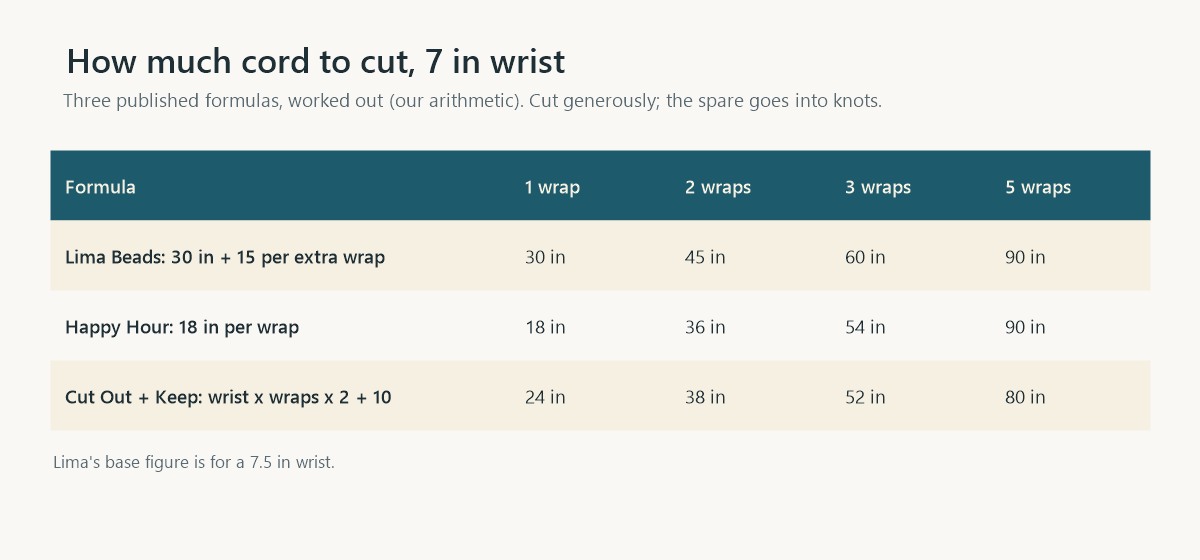
The formulas differ, but land close together.
Lima Beads cuts 30 inches for one wrap on a 7.5 inch wrist and adds 15 inches per extra wrap. Happy Hour cuts about 18 inches per wrap. A Cut Out + Keep project multiplies wrist by wraps by two, then adds 10 inches for knots. For three wraps on a 7 inch wrist, they give 52 to 60 inches.
Cut generously; the spare is lost in knots. Test the fit often by wrapping the work around your wrist as you go, as Lima Beads advises, and check that the button passes through the loop before you trim anything.
Memory wire
Memory wire needs no clasp. Fire Mountain Gems describes it as steel with 12 continuous loops, cut to the number you want, with a small loop turned at each end to hold the beads; its sample bracelet uses 6 loops. Potomac Beads notes that it goes on and comes off by coiling around the wrist, so one bracelet fits a range of wrists.
Memory wire is stiff, so it suits round beads and short repeats rather than a loomed picture. Use memory wire shears: WireJewelry warns that memory wire will damage ordinary flush cutters.
Beads that last on a wrap
On a wrap, the rounds rub against each other as well as against the skin. Fire Mountain Gems’ finish chart notes that galvanized and some coated finishes can wear with friction, so plain opaque or transparent glass, or permanent finishes, last longest. See seed bead finishes for the details, and choose a strong thread for a loomed band; see Nymo vs FireLine.
Frequently asked questions
How long should a wrap bracelet be?
About your wrist size times the number of wraps, plus the clasp. Three wraps usually come to 20 to 22 inches.
How much cord do I need for a leather wrap bracelet?
For three wraps on a 7 inch wrist, published formulas give 52 to 60 inches. Cut generously and test the fit often.
What cord is used for wrap bracelets?
Round leather in 1 mm or 1.5 mm, Greek leather, waxed linen or S-Lon, with beading thread for the lashing.
Can you make a wrap bracelet on a bead loom?
Yes. Weave a long, narrow band, joining sections if your loom is short, and finish with a toggle or button loop.
Double wrap or triple wrap?
A double wrap is about twice the wrist; a triple is about three times. More wraps need more length and a lighter band.
How do you cut memory wire?
With memory wire shears, not flush cutters, which the hard steel will damage.
Browse more Bead Loom Guides on the blog.