Bead Loom Tools: The Small Kit That Makes Loom Beading Easier

The essentials are short: a loom, beads, thread and a needle. Fire Mountain Gems’ Beginner’s Guide to Loomwork adds scissors, a ruler and cellophane tape to its list. Good light helps too: see the best light for beading.
The Clover loom tutorial lists a tape measure, scissors, a beading mat and pliers alongside the beads and thread.
Erin Simonetti, the bead loom artist whose work this site shows, keeps a few more things beside her loom. Her tips run through this guide.
The core kit
| Tool | What it does | More detail |
|---|---|---|
| Bead loom | Holds the warps a bead width apart | Choosing a loom |
| Beading needles | Carry the weft through each row | Thread and needles |
| Beading thread | Warp and weft | Thread and needles |
| Sharp scissors | Clean thread cuts | |
| Bead mat | Keeps beads from rolling | |
| Tape measure or ruler | Sizing and checking length | Cuff sizing |
Containers for your beads
Every color in a pattern needs its own container. Erin prefers stackable, twist together cups, wide enough to pick beads up with a needle. For more ideas, see how to store seed beads. For picking beads up quickly, see how to string seed beads.
I prefer this type of container, over a pill vile, tic-tac boxes or tubes, because I can use this very container while beading, since they are wide enough for my needle to pick up beads.
Erin Simonetti, How Many Colors until the ‘End of the Delica Rainbow’?
She labels each cup with its Delica number, inside and out, and keeps them in numerical order. Her one warning: buy one brand of container, since different makers use different threads and will not twist together securely.

Paper tape
Paper tape is Erin’s favorite fix for a missed bead. She keeps a strip beside the loom, sticky side up.
Using a white ‘paper tape’, I tape down a strip, sticky side up. This is something I keep by my side, while I loom, often.
Erin Simonetti, Adding a Bead is best done ‘Sticky’!
A whole row can be laid on it in order while a missing bead is added. She chose paper tape because it leaves no residue. See fixing bead loom mistakes.
Pliers, and a handkerchief
Small pliers or wire cutters crack out a bead that is the wrong size or color, without unpicking the row. Crack it away from the thread, never over it, or the glass can cut the thread.
Glass shards fly when a bead breaks. Erin’s protection is simple.
What I do for proper protection, is cover the entire pliers, holding the bead and taught weft’ with a small handkerchief.
Erin Simonetti, Garner Your Beads!
She also recommends eye protection. A small nail clipper is useful too: she uses one to cut a weft when replacing rows.
Bead stops and clips
Bead stops hold beads or thread in place while you work. Erin used them to hold a strung line of beads on a cuff while she secured it.

Weights and props for special techniques
Some techniques need their own tools.
- Warp weights for movable warps. Erin’s are lampwork glass, made by the artist Venessa Hearn. See the weighted warp method.
- A rubber wine cork to hold lifted warps up while weaving a raised layer. See layered loom weaving.
- Craft wire to straighten a wavy first row. See the first row.

Somewhere safe for needles and scissors
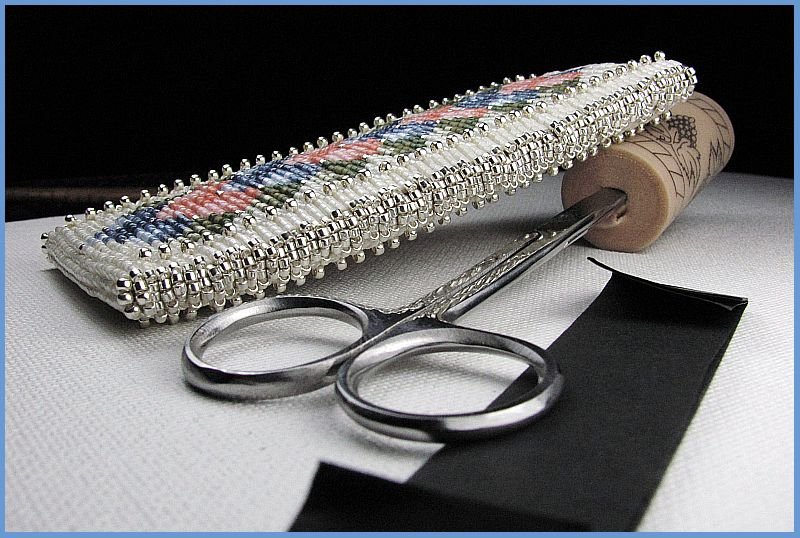
Fine needles bend and disappear; scissor tips get damaged. Erin wove herself a needle case with a bead mat inside, and keeps her scissors in a rubber wine cork. For choosing the scissors themselves, see the best scissors for beading.
This holds them well, with out any damage to the scissor tips.
Erin Simonetti, Loom Woven Needle Case & Scissor Holder!

Graphing tools and pattern software
A pattern needs a grid. Graph paper works, and Erin also has her own method for pictures.
I am also comfortable in using a method I created, before ‘bead pattern program creation’, using a graph acetate over a photograph.
Erin Simonetti, Pushing ‘2D Bead Loom Weaving’ into ‘3D’
She also designs in BeadTool 4, setting the bead width and height so shapes weave up in true proportion. See design a bead loom pattern.
Needles in more than one length
One needle length does not suit every job. Erin weaves with a #10 English needle about 2 inches long, and keeps 1 inch #10 needles for reweaving short ends during repairs. Long needles help on wide rows.
A bigger loom table for big pieces
Erin uses the same loom for most of her weaving. She changes looms only for size.
The only time I change up looms is to acquire a larger ‘loom table’, for larger pieces, sized larger then the loom.
Erin Simonetti, Wave Good-Bye to ‘First Row Ripples’!
Glue, for some finishing methods
Some finishing methods use glue. The Clover bracelet tutorial knots the warp pairs and secures them with E6000 glue before attaching the clasp. Finishing methods vary, so check the instructions for your project. To choose one, see the best glue for beading.
Thread conditioner
Wax or thread conditioner helps nylon thread. The Shipwreck Beads thread guide notes that waxing adds strength and reduces fraying. Nymo and KO come pre-waxed.
A notebook
Erin keeps a journal beside the loom, because ideas arrive while the hands are busy.
Thus is a good reason to have a journal by you, while beading.
Erin Simonetti, Simply Edge while making clasp
A notebook is also the place to record row counts for each cuff size and bead type, so you can size the next piece. See bead loom cuff clasps.
A tool checklist
- Loom, beads, thread and needles
- Sharp scissors and a bead mat
- One container per color, labeled
- Tape measure or ruler
- Paper tape for saving a row
- Pliers or cutters, and a handkerchief
- Bead stops
- Thread conditioner
- A notebook
- Warp weights and a cork, for weighted and layered work
Frequently asked questions
What tools do I need for loom beading?
A loom, beads, thread, needles, sharp scissors and a bead mat, plus containers for each color and a tape measure. Pliers and paper tape help with fixes.
What is a bead mat for?
It stops seed beads from rolling and bouncing, so they are easy to pick up with a needle.
How do you remove a wrong bead without unpicking the row?
Crack it with pliers, gripping it away from the thread so the glass does not cut it, and cover the pliers with a cloth to catch the shards.
What are warp weights?
Weights hung from some warps so they can move during weaving, used in the weighted warp method.
Start your first project with loom beading for beginners, or browse more Bead Loom Guides on the blog.