Layered Loom Weaving: Weaving a Second Layer Above the Base
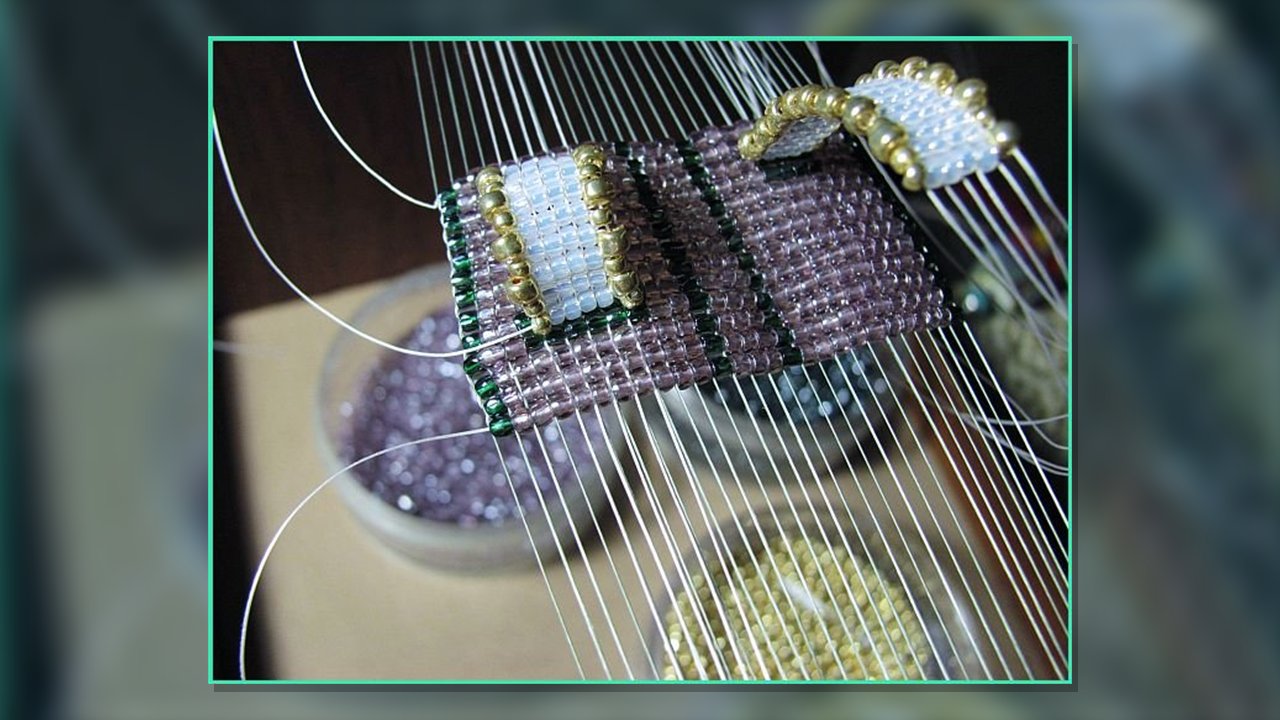
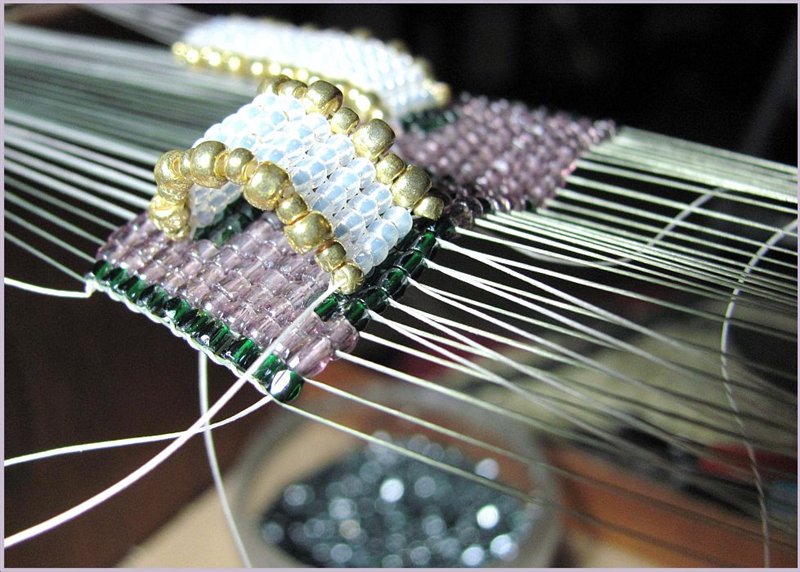
Most 3D loomwork is added after weaving: petals, appliques or outlines sewn onto the flat base. Layered loom weaving is different. The raised part is woven on the loom, on its own warps, at the same time as the base.
Erin Simonetti calls it "Layered Loom Weaving". She developed it with a tool of her own: warp weights made from lampwork beads.
My last entry was sharing a ‘new tool’ I created to help me finalize a new and different loom weaving technique I call "Layered Loom Weaving".
Erin Simonetti, Layers Of Loom Weaving!
How it differs from other 3D methods
| Method | Where the layer is made | Joined to the base by |
|---|---|---|
| Layered loom weaving | On the loom, on extra weighted warps | Its own warps, woven back into the base |
| Bead tole | Woven separately, stacked in perspective | Stitching |
| Square stitch applique | Hand woven off the loom | Stitching |
For the other two, see our guides to seed bead tole and bead loom embellishment.
What you need
- A loom with room for weights. Erin used a horizontal loom so the weighted warps could hang over the edge.
- Warp weights. Hers are heavy lampwork beads, each holding five warp threads.
- A contrasting thread to learn with. She used white weighted warps beside light green fixed warps so each set was easy to see.
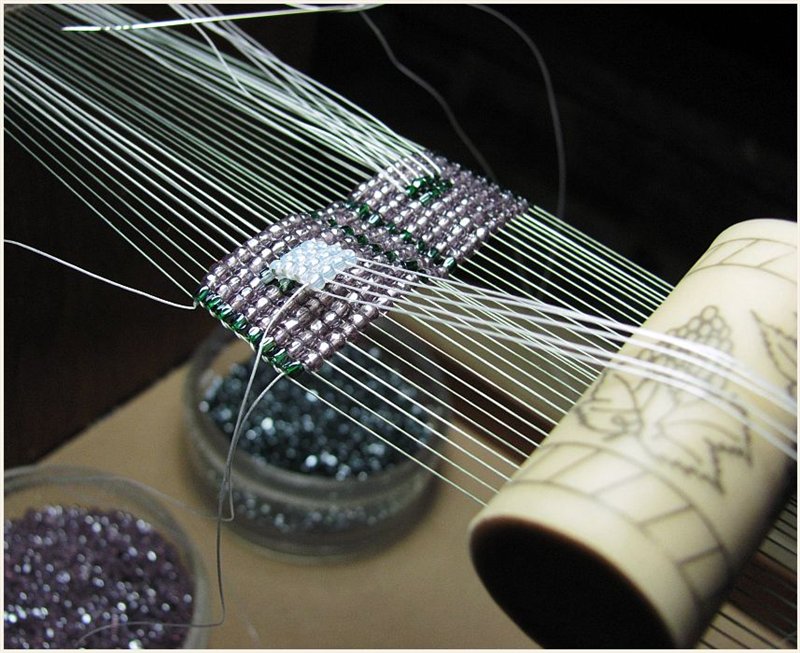
- Something to hold the raised warps. A rubber wine cork keeps them up while you weave the top layer.
- Even beads. Delicas, or other very uniform beads, so both layers stay square.
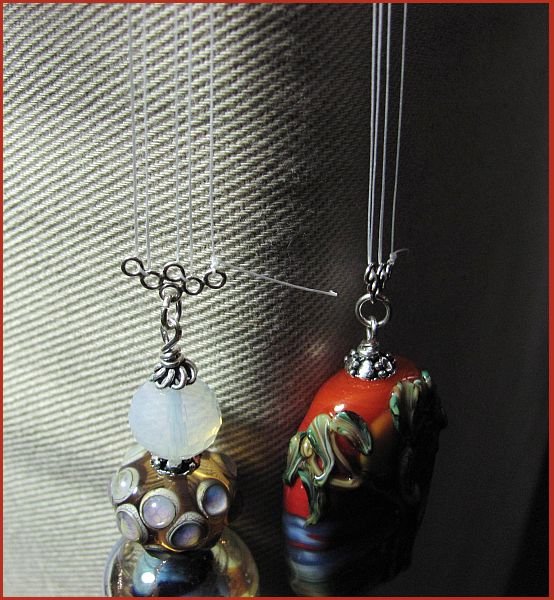
The weights are the same idea as her weighted warp method, used here for a different purpose.
Step by step: weaving a raised ribbon
The steps follow her post Layers Of Loom Weaving!, where she wove a ribbon that meanders over a loomed cuff.
- Weave the first rows with every warp. The weighted warps lie parallel to the fixed warps, and some warps are doubled in these rows.
- Set the weighted warps aside. Weave the base on the fixed warps only. The weighted warps stay evenly spaced because they are anchored in the first rows.
- Lift the weighted warps. Hold them up over a rubber cork and weave the raised layer, the ribbon, on them alone.
- Trim the layer. Erin edged the ribbon in gold.
- Bring the warps back down. When the ribbon is long enough, weave the weighted warps back into the next row of the base.
- Repeat. Each "in and out" adds another rise of the ribbon.
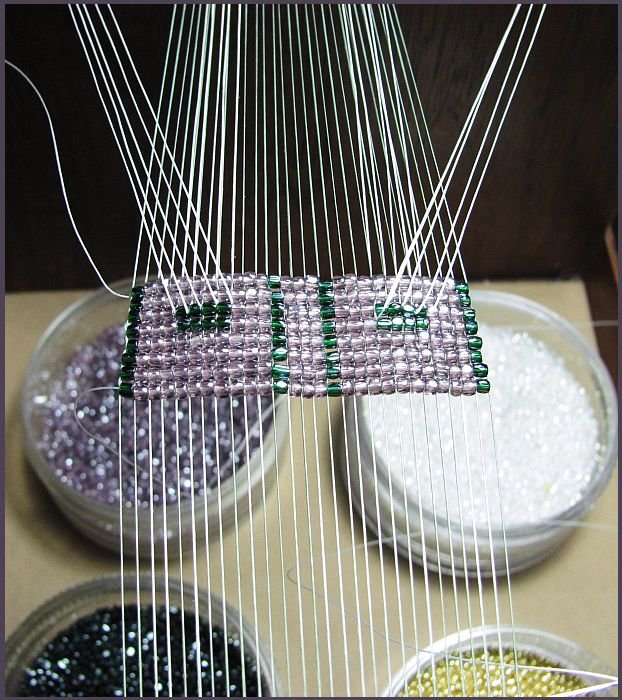
Because these added warps are secured to the lamp work weights, they are movable and easily adjusted, all the while staying the same distance apart, row to row.
Erin Simonetti, Layers Of Loom Weaving!
Allow for the bend of a cuff
This is the easiest step to miss. A raised layer that looks right on the flat loom will lie flat once the cuff curves around a wrist.
If you are not considering the extra length of the ribbon section, it won’t sit up and away from the loomed base, while wearing.
Erin Simonetti, Layers Of Loom Weaving!
Weave each raised section a little longer than the gap it spans. Erin judged the curve she wanted by looking at where each section would rejoin the base.
Designing with layers
A ribbon is only one idea. Erin’s ribbons rose and rejoined at different points along the cuff, and later merged into one wide ribbon.
Her bead choice matters here too. She tried the technique with cut glass beads that were not evenly sized, and could not cull them into a uniform weave.
You may take my loom, but let me keep my Delica’s!
Erin Simonetti, Layers Of Loom Weaving!
A finished example: the Peeking Duck cuff
Erin later used layers for a cuff with a Chinese theme, titled with a pun: "Peeking Duck". The duck and a gold "Prosperity" medallion sit on the base, and a graphed dragon scroll rises above them.
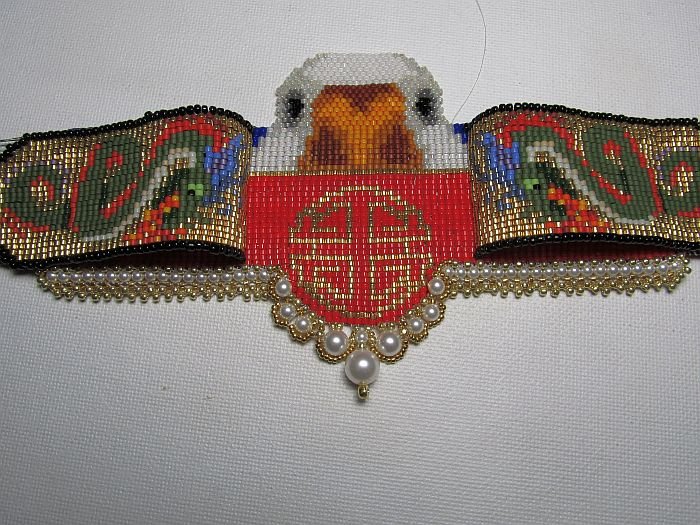
The layered looming was created by looming directly ‘over top’ of the original base looming.
Erin Simonetti, Layered Weave Titled, "Peeking Duck"!
The two layers have different jobs. The upper layer holds the clasp, her "crunchy clasp" end caps. To keep the layers apart, she beaded tubes shaped like Chinese lanterns, attached to the base but not to the upper layer.
Leaving the tubes loose lets them move, which she liked. She also found a stiffer warp worked better for the second layer.
A stiffer type of warp worked out perfect, weaving the second layer.
Erin Simonetti, Layered Weave Titled, "Peeking Duck"!
Woven layer or square stitch applique?
Erin was honest about the alternative. The same ribbon could be hand woven in square stitch and sewn on.
There is less work creating this idea in this manner, with less threads to hide and secure.
Erin Simonetti, Layers Of Loom Weaving!
| Layered loom weaving | Square stitch applique | |
|---|---|---|
| Work | More warps to manage and hide | Less thread to hide |
| Join | Woven into the base on its own warps | Sewn on afterwards |
| Suits | Weavers who think in warps and wefts | Confident off-loom stitchers |
She chooses the loom because she thinks in warps and wefts, and because her warp management techniques make the extra warps disappear.
Tips before you try it
- Practice in two thread colors. It makes the fixed and weighted warps easy to tell apart.
- Start narrow. A five warp ribbon is easier to handle than a wide layer.
- Lengthen raised sections to allow for the curve of the finished piece.
- Keep tension steady on both sets of warps. See bead loom warp tension.
- Plan the clasp. A layer can carry it, as on the Peeking Duck. See bead loom cuff clasps.
Frequently asked questions
What is layered loom weaving?
A technique by Erin Simonetti in which a second layer of beads is woven on the loom above a woven base, using extra warps hung from weights.
Do I need a special loom for layered loom weaving?
You need a loom where weighted warps can hang freely. Erin used a horizontal loom with the weights hanging over the edge.
Why does my raised layer lie flat when worn?
It needs extra length. A cuff bends around the wrist, so weave each raised section a little longer than the gap it spans.
Is layered loom weaving the same as bead tole?
No. In layered loom weaving the layer is woven on its own warps on the loom. In bead tole, separately woven pieces are stacked in perspective.
See more of Erin’s dimensional pieces in Wearable Art, or browse more Bead Loom Guides on the blog.