How to Make a Bead Loom Anklet That Fits and Lasts
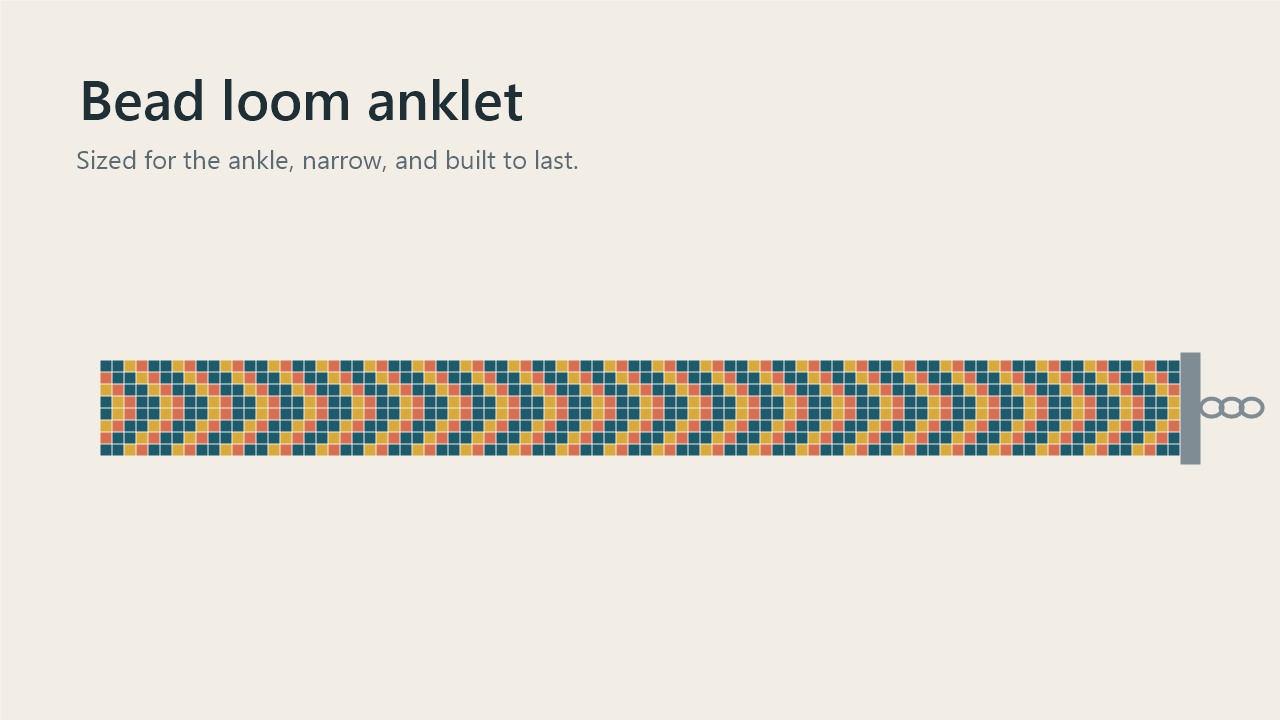
A loomed anklet is woven exactly like a bracelet, but it is longer, and it is worn where shoes, socks, sand and water reach it. Those differences change the sizing, the width, the clasp and the choice of beads.
This guide draws on bead shops’ sizing and finish data, and on the cuff advice of Erin Simonetti, the bead loom artist whose work this site shows. Erin did not make anklets, so her words here are her general rules for loomed bands, applied to an ankle.
Measure the ankle
Measure the same way as a wrist, but at the ankle bone. CJ Beaders says to wrap a flexible tape measure, a strip of paper or a ribbon snugly around the ankle, on the ankle bone.

CJ Beaders puts a typical anklet at about 9 inches, with a range from 8 to 11. It adds that dainty styles should be shorter, and chunky ones longer, though beads that hang too low can become a tripping hazard. For the measuring methods in detail, see the bracelet size chart.
How long to make it
Fire Mountain Gems lists standard anklet lengths of 9 to 10 inches for women and 11 to 14 inches for men. Those are finished lengths, including the clasp.
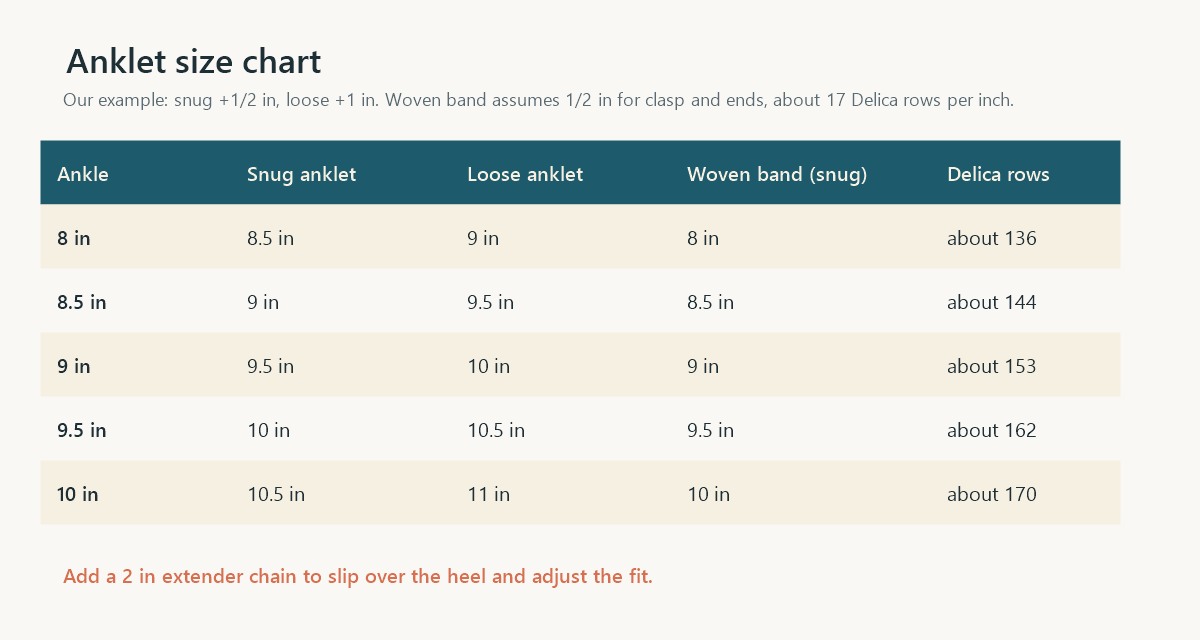
| Ankle | Snug anklet | Loose anklet | Woven band, snug, 11/0 Delicas |
|---|---|---|---|
| 8 in | 8 1/2 in | 9 in | About 136 rows |
| 8 1/2 in | 9 in | 9 1/2 in | About 145 rows |
| 9 in | 9 1/2 in | 10 in | About 153 rows |
| 9 1/2 in | 10 in | 10 1/2 in | About 162 rows |
| 10 in | 10 1/2 in | 11 in | About 170 rows |
The table adds half an inch for a snug fit and an inch for a loose one, as on the bracelet chart. The woven band assumes a clasp and ends of about half an inch, and about 17 rows per inch, the count Erin gives for 11/0 Delicas on her loom. Your own count depends on your tension, so weave a test patch. To work out bead counts, use the bead loom calculator.
How wide to weave it
Narrow is the rule. An ankle bends more than a wrist, and a wide, stiff band rubs on the top of the foot and catches on socks.
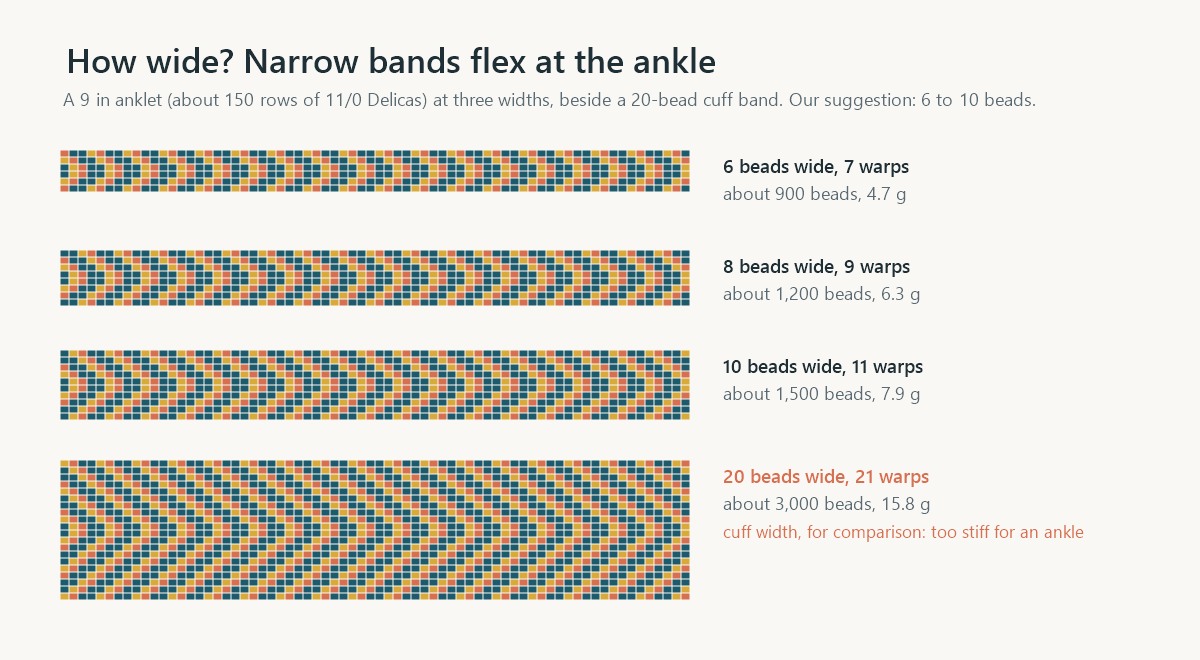
A band 6 to 10 Delicas wide is about a third to a half inch. That is our own suggestion from loom geometry, not a published rule. At 8 beads wide and about 150 rows, an anklet uses about 1,200 beads, or roughly 6 grams of Delicas. See how many seed beads per gram.
Patterns for a narrow band
A band 6 to 10 beads wide has little room for pictures, so simple repeats work best. Stripes, small chevrons, checks and diamonds all read well at this width, and a repeat of a few rows is easy to stop neatly at the clasp. See geometric bead loom patterns for how to chart them, including why an odd width gives a single centre point.
Keep colours bold and few. An anklet is seen from a distance, at the bottom of a leg, so fine shading is lost. Two or three high-contrast colours make a clearer pattern than a subtle fade.
Strong edges and warps
The outer warps take the wear. Erin reinforces them:
The loomed beads will hold themselves together throughout the looming, so I reinforce the end warps. This is also a more affordable means to warp your loom, as opposed to using a more expensive, durable thread throughout the warps!
Erin Simonetti, Techniques
Skip fringe and dangles off the bare outer warp. On a cuff, Erin warns that a snagged fringe on the outer warp is far harder to repair than one on a separate edging base:
But if you choose to do the peyote base on the outer edge and your fringing snags, think how much easier it would be to ‘repair’ the brick stitch base, as opposed to replacing an outer warp (if you fringe from the outer warp only), should the edging snag/break, under normal wear and tear.
Erin Simonetti, Having the edge on!
Shoes and socks snag more than sleeves, so this matters even more at the ankle. For thread strength, see Nymo vs FireLine, and for edges, bead loom edges.
Clasps and extenders
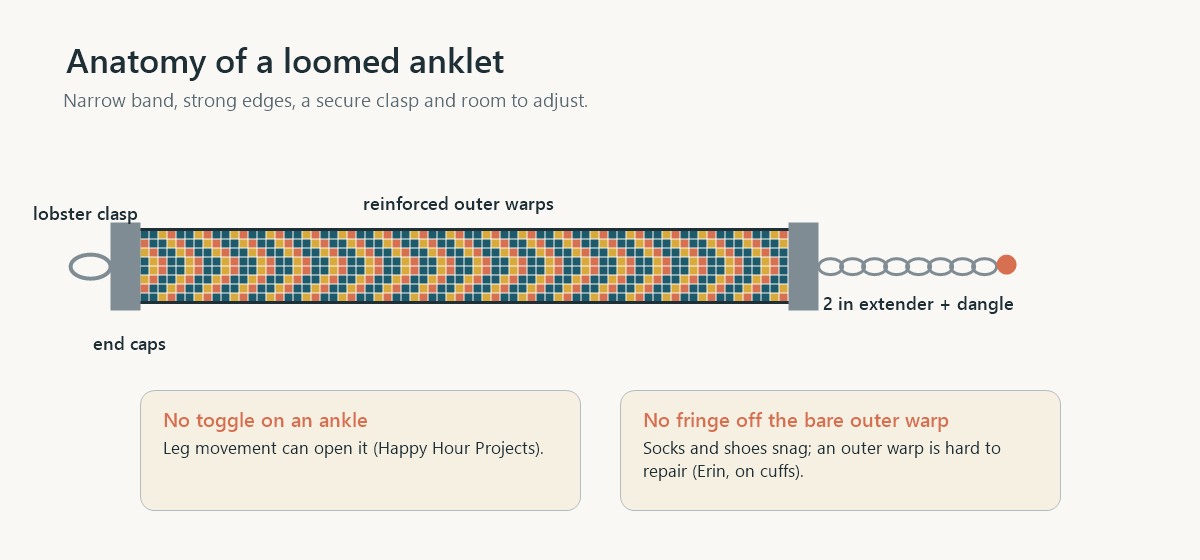
A lobster clasp with an extender chain is the usual choice. Happy Hour Projects advises against toggles on ankles, because of how much legs move. Ready-made extenders of about 2 inches are sold for anklets; one bead shop’s netted anklet is 9.5 inches without its extender and 11.5 inches with it.
An extender also solves the hardest part of sizing: getting over the heel. For other closures, including a sliding knot, see how to make an adjustable beaded bracelet.
Beads that stand up to feet
Anklets meet friction, sweat, sand and water. Some bead finishes cope far better than others. Fire Mountain Gems’ finish durability chart notes that galvanized, metallic and some coated finishes can wear with friction, and it recommends avoiding water, perfumes and harsh chemicals.

Plain opaque or transparent glass, with colour in the glass itself, is the safest choice. If an anklet will go to the beach, test a bead first. Fire Mountain Gems explains how to test materials for colourfastness to salt water, chlorine and perspiration in its colourfastness guide. Then take the anklet off before swimming.
Erin’s aim for all her pieces applies here:
I love to work on making my art durable and wearable, such as this ring keeping it’s shape!
Erin Simonetti, Finger Rings
For care, see care for loomed beadwork. For summer colours, see summer bead loom designs.
Frequently asked questions
How long should a beaded anklet be?
Usually 9 to 10 inches for women and 11 to 14 inches for men, including the clasp. Measure the ankle, then add about half an inch to an inch.
How do I measure my ankle for an anklet?
Wrap a flexible tape, a paper strip or a ribbon snugly around the ankle, over the ankle bone, and read the length.
How wide should a loomed anklet be?
Narrow: about 6 to 10 Delicas, a third to a half inch. A wider band is stiffer and rubs on the foot.
Should I add an extender chain to an anklet?
Yes. A 2 inch extender with a lobster clasp makes it easy to get over the heel and adjusts the fit.
Can I wear a seed bead anklet in the pool or the sea?
Best not. Water, salt and chlorine can weaken thread and affect coatings. Test the beads, and take the anklet off to swim.
What clasp is best for an anklet?
A lobster clasp with an extender. Toggles can open with the movement of the leg.
Browse more Bead Loom Guides on the blog.