Creative Bead Loom Edges: Scallops, Picots and Brick Stitch
Bead loom edges have a reputation for being straight and plain. That reputation is only half deserved.
The edge of a loomed piece is where you can add the most personality, and also where the work is most exposed. A good edge does both jobs at once.
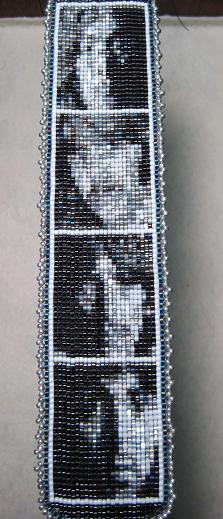
Many times I have been told, "Looming is not as creative as hand weaving. The edges are always straight." I am here to show that looming can offer many creative edges and finishes.
Erin Simonetti, Techniques
Why bead loom edges matter
A woven edge can look finished on its own, but it usually shows the weft turns and the outer warp. Those threads can snag, wear or break.
Edging covers them, firms up the sides and gives the eye a clean frame around the design.
Rule of thumb: Never show thread or bead guts.
Erin Simonetti, Having the edge on!
Two ways to get a creative edge
There are two broad routes. You can shape the edge while you weave, or you can add an edge after the weaving is done.
| Approach | How it works | Best for |
|---|---|---|
| Shape while weaving | Rows step in and out using movable warps | Wavy outlines, indents and cut-outs |
| Add an edge afterward | Beads are stitched along the finished side | Picots, loops, fringe and scalloped bleeds |
Shaping while you weave needs a special setup. Erin uses her weighted warp method for this, and in a later post describes including edge extensions as she weaves rather than adding them by hand afterward.
The rest of this guide focuses on the second route: edges added to a finished woven side.
Choose the base first
Before you pick a style, decide what the edge will sit on. Erin describes only two options.
| Bead base | Brick stitch base | |
|---|---|---|
| What it is | The edge starts from a bead added at each row of weaving | A row of brick stitch is hand-woven along the outer warp |
| Bead choice | Base bead decides the look; a cylinder bead lies neatest | Any size or shape of bead can sit on it |
| Rows | Follows the woven rows exactly | You choose when to skip a row so it lies flat |
| Strength | Anchored in the woven beads | Anchored along a doubled outer warp |
| Watch out for | Thread turns showing between rows | Open beads and long thread spans to cover |
To learn the stitch itself off the loom, see brick stitch beading.
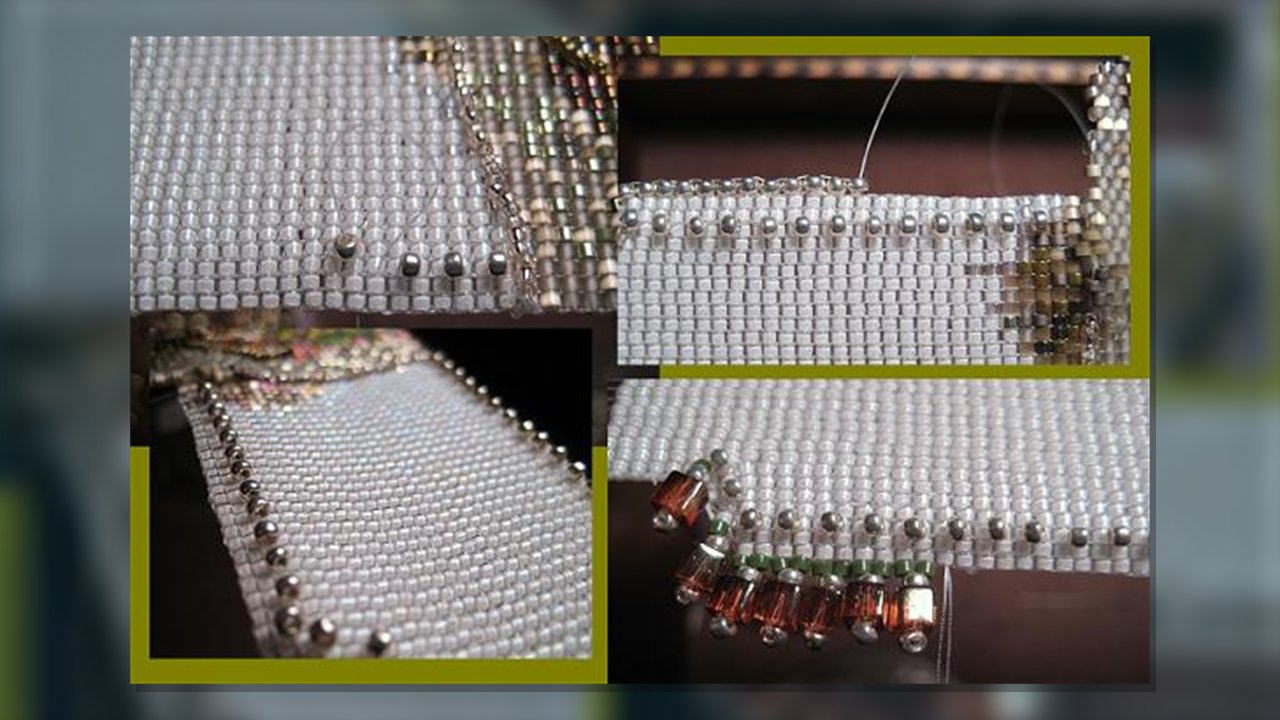
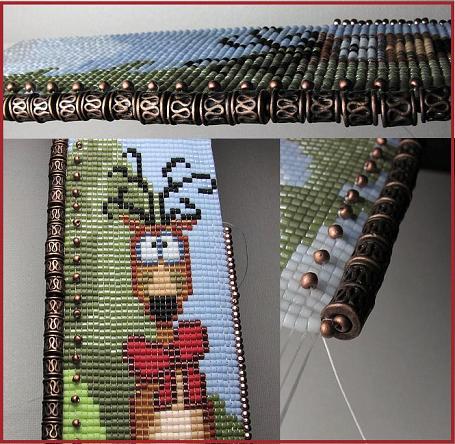
With a bead base, the base bead matters. In her tests, an 11/0 seed bead next to woven 11/0 Delicas made the edge bunch slightly, which can be a nice look. Starting with an 11/0 Delica, the same size and shape as the weave, made the edge lie neater.
If you must turn the thread on a graphed pattern, she suggests turning light thread around light beads and dark thread around dark beads, and staggering the turns so they do not show.
Bead loom edge styles to try
Once the base is in place, these are the styles Erin describes in her edging post, plus the classic picot.
| Edge style | What it looks like | Good for |
|---|---|---|
| Picot | Small points of beads along the edge | A simple, tidy finish |
| Loop edge | Beads looped up and down along the base | Soft texture with the same or contrasting beads |
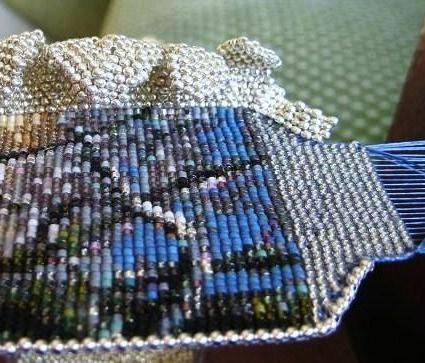
| Lower bleed | A scalloped edge draping over the loomed edge | Adding movement without hiding the design |
| Double lower bleed | Scallops layered further over the weave, toward netting | Graphic or simple woven designs |
| Upper and lower bleed | Scallops above and below the base | A dramatic frame |
| Upper bleed with fringe | Fringe or picot on the upper side | Letting fringe take center stage |
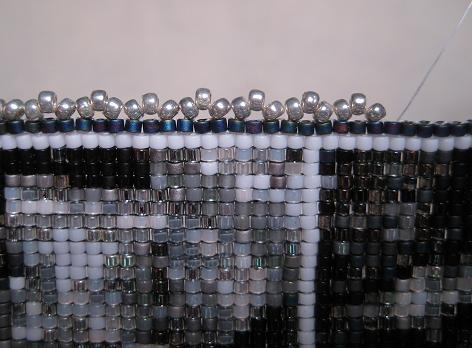
For a step-by-step look at the basic picot, Artbeads has a clear tutorial on how to make a picot edge.
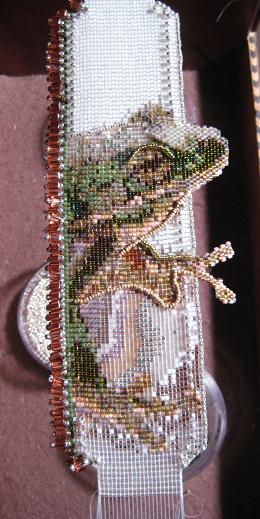
A picot is also a good fix for a brick stitch base. After brick stitching, Erin notes there can still be an open bead and wide stretches of thread. A picot in and out of each seed bead covers them.
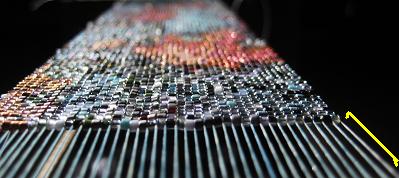
Strengthen the outer warp
The outer warp carries more strain than any other. Erin recommends a sturdier thread there.
If you use a sturdy warp thread, for the outer most warp, on each side, you can be very creative, in how you complete your piece.
Erin Simonetti, Techniques
For a brick stitch base, she doubles the outer warp for strength. Even so, the outer warp alone is not a safe anchor for a heavy or swinging edge.
Please do not consider adding a beaded edge, with any weight or movement, by using ‘just the outer warp’.
Erin Simonetti, Having the edge on!
Her reasoning is practical. The weight of a frilly edge, or a snag on a picot, can cut or break a lone warp. Anchoring the edge in the woven beads, or in a brick stitch base, is far more secure.
Edge on the loom or off it?
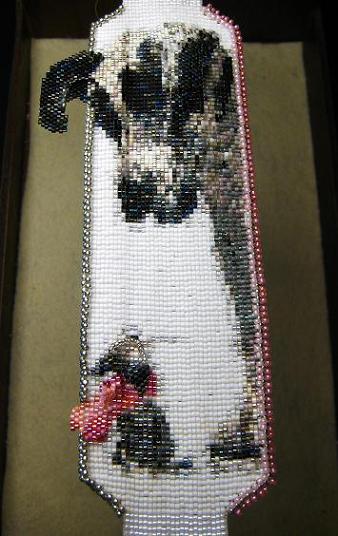
Some beaders cut the piece free before edging. Erin prefers to edge on the loom.
| On the loom | Off the loom | |
|---|---|---|
| Pros | Work is held flat; thread is less likely to tangle in finished edging | No effect on warp tension |
| Cons | Edging can pull outer warps into the end beads | Piece moves around while you stitch |
If you edge on the loom, keep an eye on tension, since edging can shrink the outer warps. Our guide to bead loom warp tension explains what to watch for.
Plan the edge with the design
The best edges are planned with the pattern, not added as an afterthought. A few questions help before the first edge bead goes on:
- Will the edge stay simple, or carry fringe and movement?
- Should it bunch slightly for texture, or lie perfectly flat?
- Does the design need a frame, or should the edge drape over it?
- Will it be stitched on the loom or after cutting?
Dimensional pieces raise the stakes, because the edge has to work with raised parts of the design. Our bead tole guide covers that side of her work.
Frequently asked questions
How do I make a scalloped edge on loom beadwork?
Add a secure base first, either a bead base from the woven rows or a brick stitch row, then work scallops that drape over the loomed edge. Erin calls this a lower bleed.
Can I stitch an edge onto just the outer warp?
Not if the edge has weight or movement. A heavy edge or a snag can break a lone warp. Anchor the edge in the woven beads or a brick stitch base.
What is the neatest base bead for a loomed edge?
A bead the same size and shape as the woven beads. In Erin’s tests, an 11/0 Delica base lay neater against Delica weaving than an 11/0 seed bead.
Should I edge before or after cutting the piece off the loom?
Either works. Edging on the loom keeps the piece steady, but check the warp tension, because edging can shrink the outer warps.
Explore finished edges across Erin’s work in her loomed earrings and cuffs, her beaded wedding wear, and Beaded Jewelry Gallery 1. The full set of her tips is on the bead loom techniques page.