A Short History of the Bead Loom, From Bow Looms to the Apache Loom
Today’s bead looms come in metal and wood, with springs, rollers and tension knobs. The idea behind them is much older: hold the warps a bead width apart, and weave the beads in between.
This is a short history built from museum records and primary documents. Where the records are unclear, we say so.
Woodland bow looms and box looms
The Milwaukee Public Museum describes two early forms used for Woodland Indian beadwork.
| Loom | How the museum describes it |
|---|---|
| Bow loom | A bent stick with doubled-up birchbark heddles attached to each end |
| Box loom | A rectangular frame with the warp threads strung over the end bars |
The museum notes that the bow loom was the earliest of the two. With looms, it says, Woodland Indian women made strips of woven beadwork for belts, garters, headbands, necklaces and decorative bands.
It also notes that loom work is difficult to tell apart from one nation to another, so a loomed piece rarely shows its maker’s community on its own.
Glass beads and the trade
Loom beadwork depends on small, even glass beads. The same museum page explains that glass beads became available after contact with Europeans.
Beads made in Venice, and later in what was then Czechoslovakia, were commonly sold at trading posts and reservation stores. Smaller beads suited to embroidery were also widely sold in the nineteenth century.
A loomed belt from about 1880 to 1900
Museum collections hold loomed pieces from the late nineteenth century. One example is a loom beaded belt shared by the Manitoba Crafts Museum and Library in an online exhibit.
The museum attributes it to the Anishinaabe, about 1880 to 1900, from the north midwestern US, northwestern Ontario or Manitoba. It describes a long, thin panel of multicolored floral patterns, loom woven together with thread.
Bead looms for hobbyists, around 1900
By 1900, bead looms were being sold as home craft kits. The Victoria and Albert Museum holds one, made in England about 1900 and titled "Apache" by its manufacturer, Faudel, Phillips and Sons.
It has a flat base, a pivoting reed and three pegs to hold the warp, with wooden reeds to separate the warp threads. Its box is labeled for weaving "Indian Beadwork", and the museum lists belts, sashes, chains and fobs among the things it was for.
The name was a sales label. The museum record names no Native maker, and the loom was made by an English manufacturer.
A 1903 patent
In the United States, Theodore F. Damm of Milwaukee was granted US patent 736,701 in August 1903 for a loom or frame for beadwork.
His design had two sliding sections fixed with a wing nut, so the length could be adjusted, and upright spacing fingers at each end. The warps ran between the fingers and the beads were pressed up into the spaces between them. The patent names watch fobs, chains, belts, collars and hat bands as uses.
| V&A "Apache" loom | Damm patent loom | |
|---|---|---|
| Date | About 1900 | Patented 1903 |
| Origin | Made in England | Patented by an inventor in Milwaukee, Wisconsin |
| Warp spacing | Wooden reeds | Upright spacing fingers |
| Adjustable length | Not described | Yes, sliding sections |
Heddle bead looms
Some early commercial bead looms used heddles, which lift alternate warps so the weft can pass between them. The Wikipedia article on bead weaving notes that heddle bead looms were popular in the United States near the beginning of the twentieth century, and that a few are still made today.
Most beaders now weave without heddles, with the beads held between fixed warps by the weft. Our guide to the best bead loom for cuffs compares heddle and tension looming.
A surviving 1930s "Apache" loom
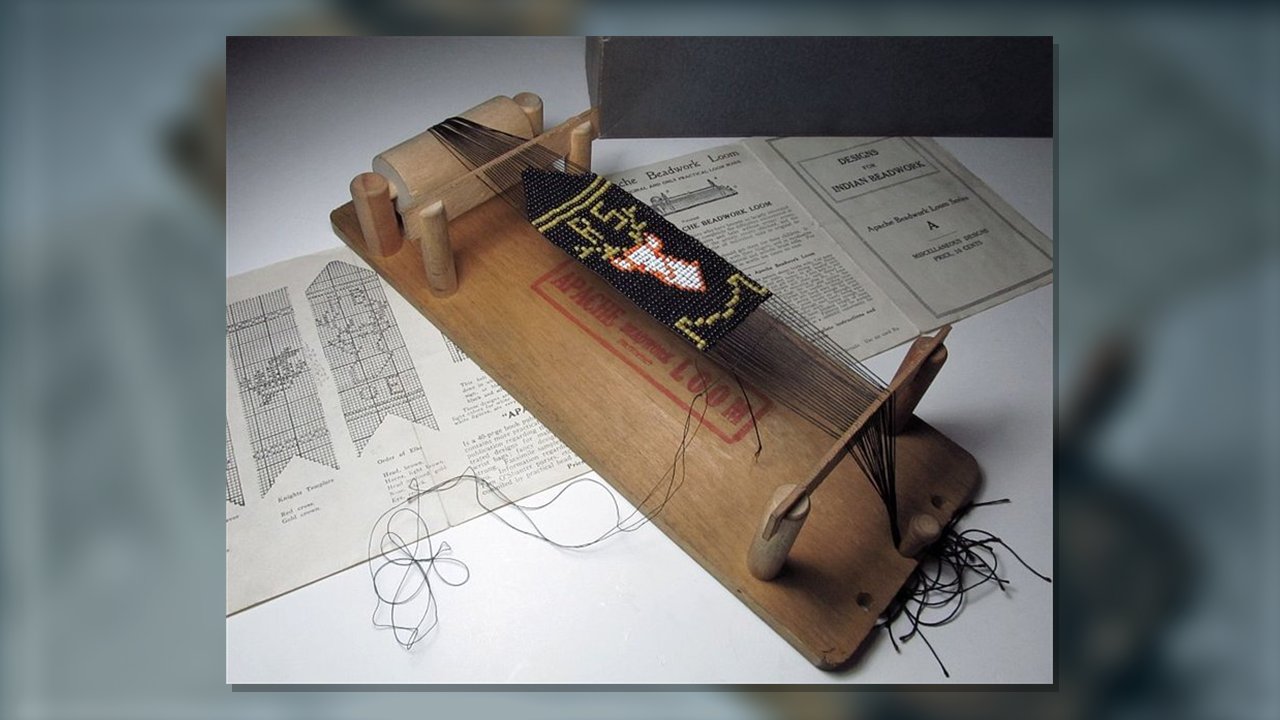
Erin Simonetti, the bead loom artist whose work this site shows, owns an Apache bead loom she dates to about the 1930s. It came with its fold out instructions, a spool of thread, its pegs, charted designs and a half finished piece still on the loom.
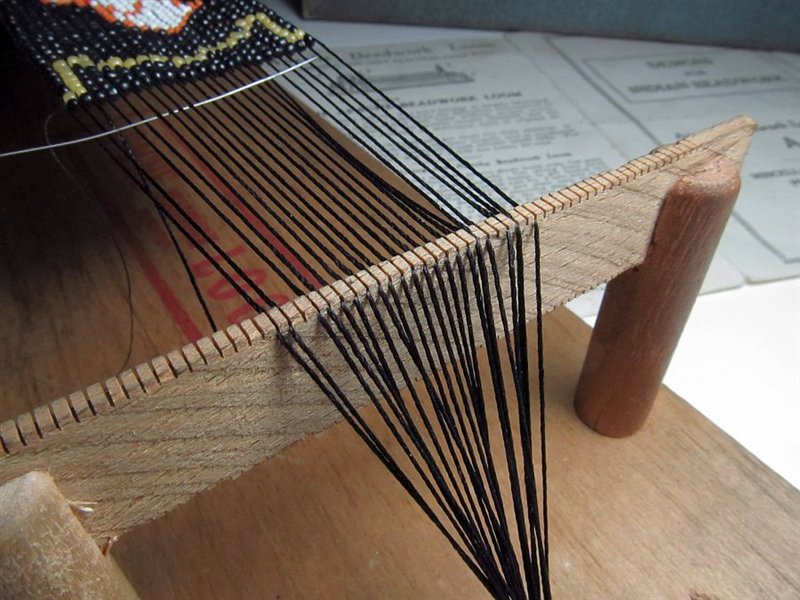
Her post describes how it works. The warps are knotted, hooked on a tack in the single roller, and laid in notches in a "fret" at each end. The far ends are wedged in a notch in the base with a plug.
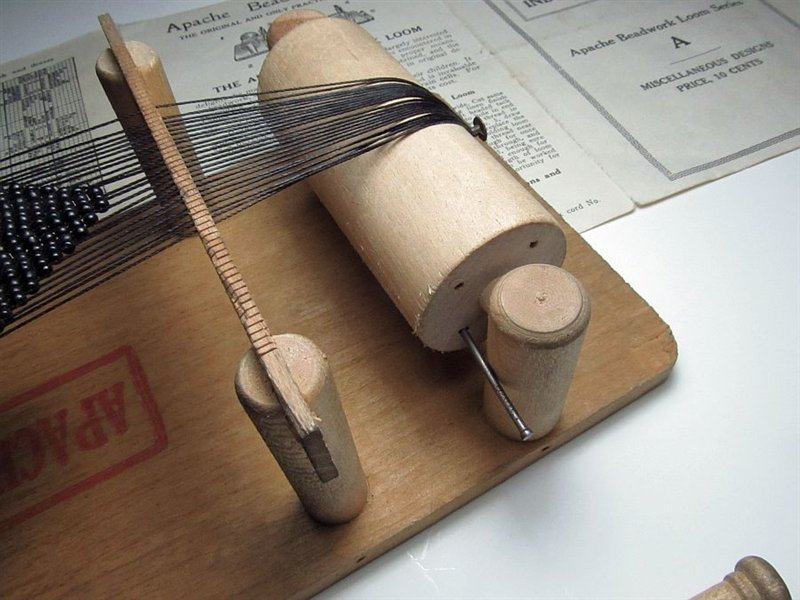
Tension is set by removing the plug, pulling the warps and replacing it. Her post also records the instructions’ advice to use a strong linen finish thread or silk.
The instructions sold the loom as an education, too. Erin quotes them:
"The lesson learned on a loom will help the children be skillfull with their fingers and develope their mechanical and artistic brains cells."
Erin Simonetti, Circa 1930’s Apache Bead Loom
The same instructions say little about finishing.
The directions for warp management are summed up by suggesting each warp be knotted, in groups of two, or rewoven back into the finished work.
Erin Simonetti, Circa 1930’s Apache Bead Loom
Her post says these looms were first patented in 1903. We have not been able to confirm which patent that refers to, so treat the date as the instructions’ claim.
The modern bead loom
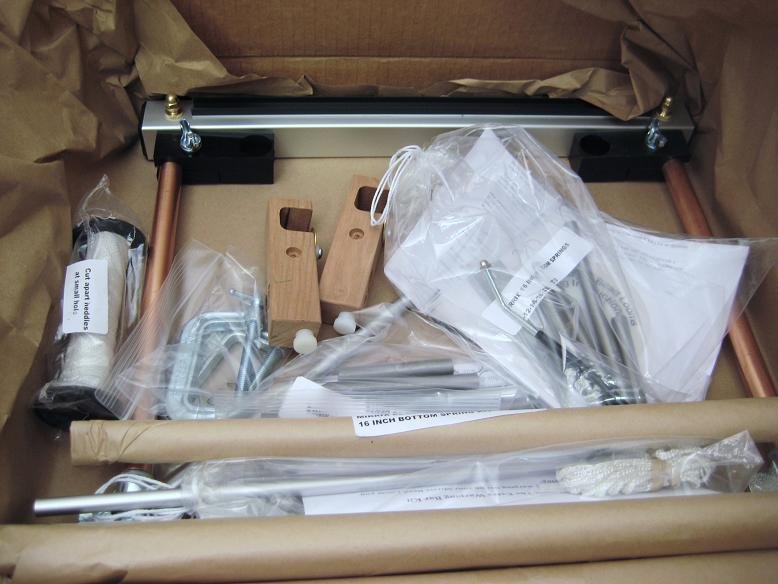
Today’s looms add the things early looms lacked: fine spacing springs, tension adjusters and longer working lengths. Erin bought a Mirrix, a metal frame loom, in 2010, and later a Mini Mirrix small enough to travel. Our guide to types of bead looms compares the looms sold today.
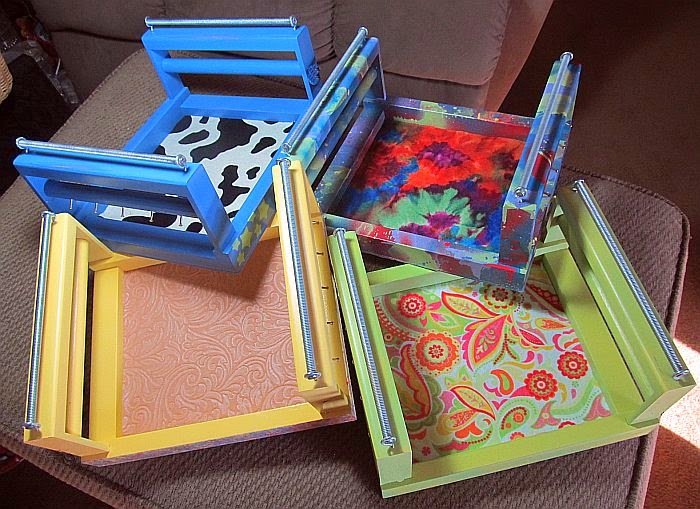
Some weavers build their own. Erin designed a loom she calls the Tri Warp Bar Loom, with warps running in three directions, and makes painted looms for her students.
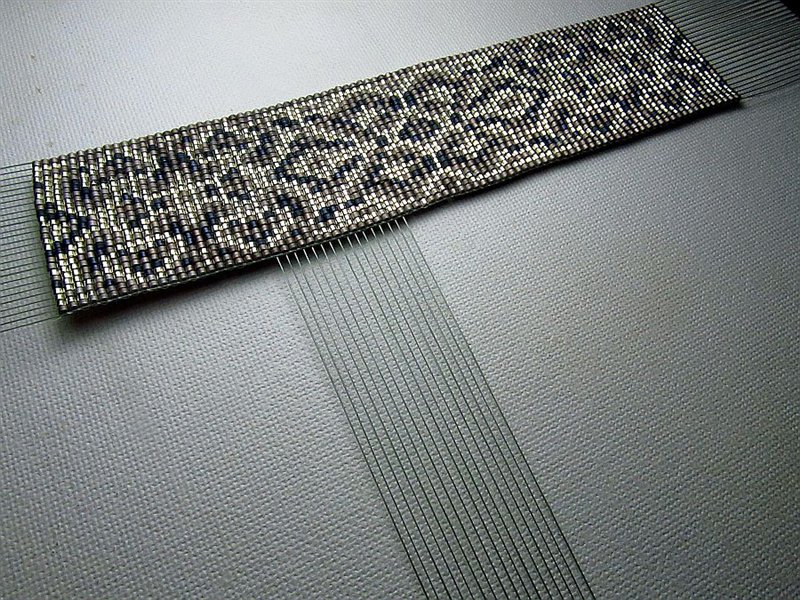
Whether it is a bent stick or a metal frame, the job is the same. To set one up, see how to warp a bead loom.
Frequently asked questions
What was the first bead loom?
The Milwaukee Public Museum describes the bow loom, a bent stick with birchbark heddles at each end, as the earliest loom used for Woodland Indian beadwork, followed by the box loom.
What is an Apache bead loom?
A commercial bead loom sold around 1900 and after under the name "Apache". The V&A holds one made in England by Faudel, Phillips and Sons.
When was the bead loom patented?
A US patent for a loom or frame for beadwork, number 736,701, was granted to Theodore F. Damm of Milwaukee in 1903.
Where did the glass beads for loom work come from?
Through trade after European contact. Beads from Venice, and later Czechoslovakia, were sold at trading posts and reservation stores.
See what Erin weaves on her modern looms in Wearable Art, or browse more Bead Loom Guides on the blog.