Geometric Bead Loom Patterns: Stripes, Chevrons and Ombre
Geometric patterns are where most bead loom weavers start, and where many keep returning. A band of chevrons or a soft ombre fade needs no drawing skill, only careful counting.
This guide covers six basic fills, the diagonal problem, odd and even widths, ombre fades and planning a repeat. It draws on bead makers’ size data and bead shops’ colour advice, and on the work of Erin Simonetti, the bead loom artist whose work this site shows.
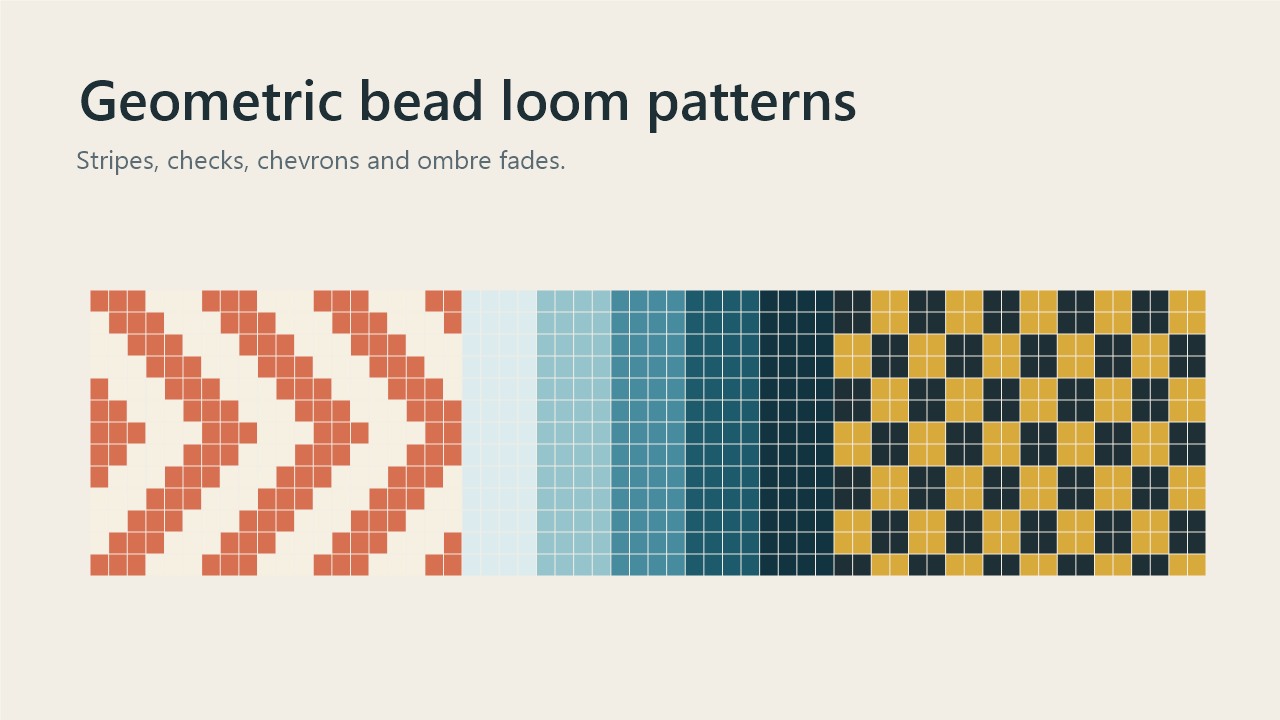
Six fills on one band

- Horizontal stripes. One colour per row. The easiest pattern on a loom: pick up one colour, weave the row.
- Vertical stripes. The same colour in the same column every row.
- Checkerboard. Blocks of two or more beads, alternating every two or more rows.
- Diamonds. Steps outward from the centre, then back in.
- Chevrons. V shapes, stacked. A chevron is simply a V-shaped mark.
- Broken checks. Small offset blocks, similar to houndstooth.
A loom bracelet tutorial from NASA’s Psyche mission team at UC Berkeley notes that many patterns are repeatable: when you reach the end, start again from the bottom. It also warns to make sure all your colours are the same bead shape.
Stripes can also come from colour value alone. Erin used two shades of one colour this way:
In the picture above, I am sharing the base of the ‘Turquoise and Dark Coral Layered Cuff’, to show how I used two intensities of Turquoise, almost creating a ‘striped’ effect.
Erin Simonetti, Wrist Corsages
Why loom diagonals are steeper than 45 degrees
On a loom, a bead lies with its hole running across the band. Its width along the row is its length; the height of each row is its diameter. Most seed beads are taller than they are wide in that position.
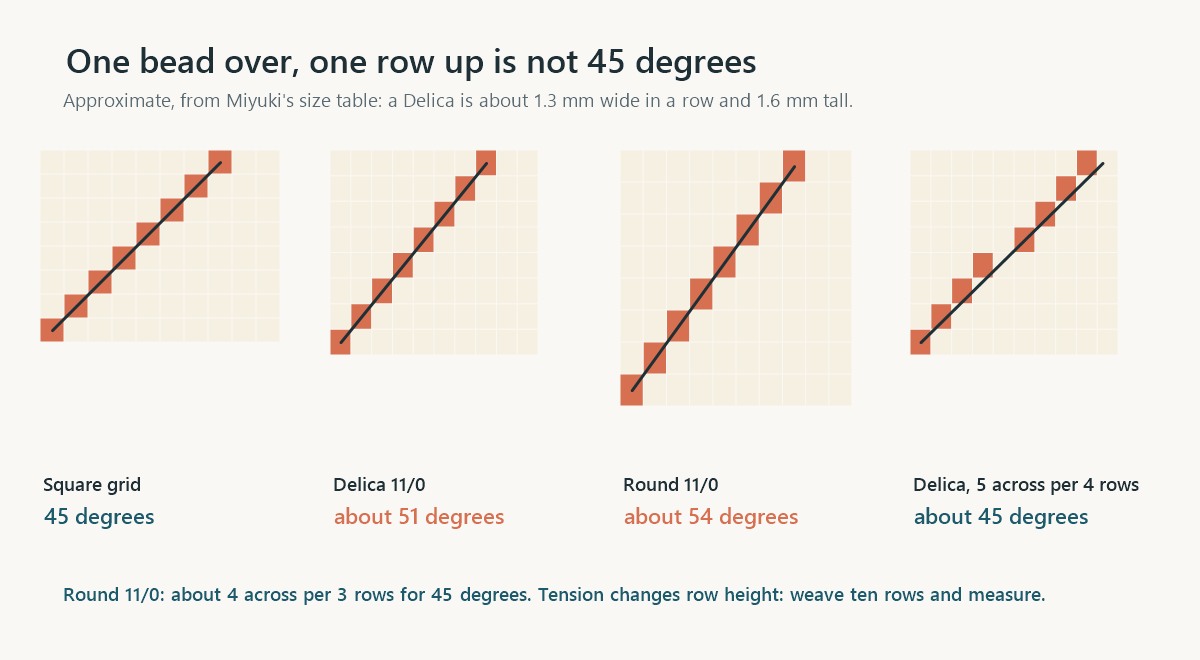
Miyuki’s size table lists the 11/0 Delica at 1.6 mm across, with about 77 beads in 10 cm, and the round 11/0 at 2.0 mm, with about 69 in 10 cm. From those figures, our own arithmetic gives these approximate angles:
| Bead | Width in a row | Row height | One-step angle | Near 45 degrees |
|---|---|---|---|---|
| Delica 11/0 | About 1.3 mm | 1.6 mm | About 51 degrees | 5 across per 4 rows |
| Round 11/0 | About 1.45 mm | 2.0 mm | About 54 degrees | 4 across per 3 rows |
The numbers vary with tension and maker, so weave ten rows and measure. The graph paper guide explains charting on bead-shaped cells.
Diagonals also change a design. Erin turned a block design onto a slant:
I love a ‘piano key’ pattern.
Erin Simonetti, Closing the gap of bead color intensity
My final graphing has this key pad on a chamfer.
Erin Simonetti, Closing the gap of bead color intensity
The slant made shading matter more, she noted, than in a straight design.
Odd or even width?
A chevron or diamond with a single-bead point needs a centre column, and only an odd width has one. An even width gives a two-bead flat point.
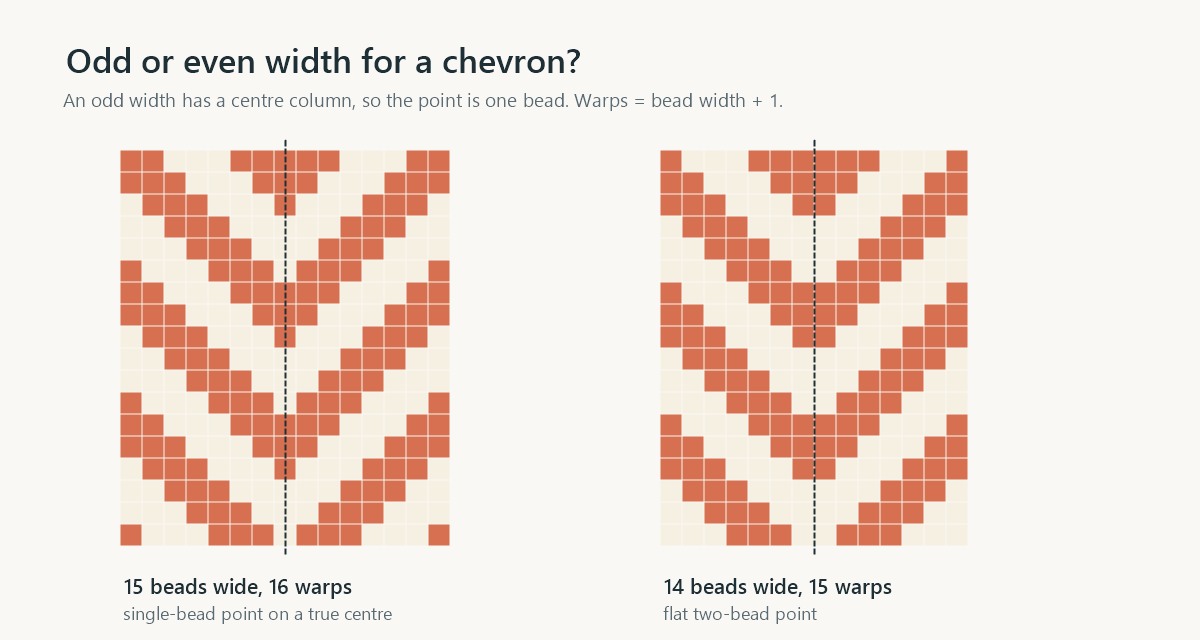
The Psyche tutorial gives the warp count as bead width plus one. So an odd bead width needs an even number of warps. Erin’s warping note shows why that matters at the loom:
If you are warping an even number of warps, the warp end will land on the same end as the starting warp. If you are warping an odd number of warps, these will end at opposite ends of the loom.
Erin Simonetti, Waning Warps
Symmetry is a choice, not a rule. Erin also warped the loom asymmetrically to try free-form designs.
Ombre fades
Ombre means a graded blend, usually light to dark. Fire Mountain Gems says a true ombre needs a gradual, subtle transition, starting with a few rows of one colour and adding one or two beads of the next. Hard transitions give stripes instead.
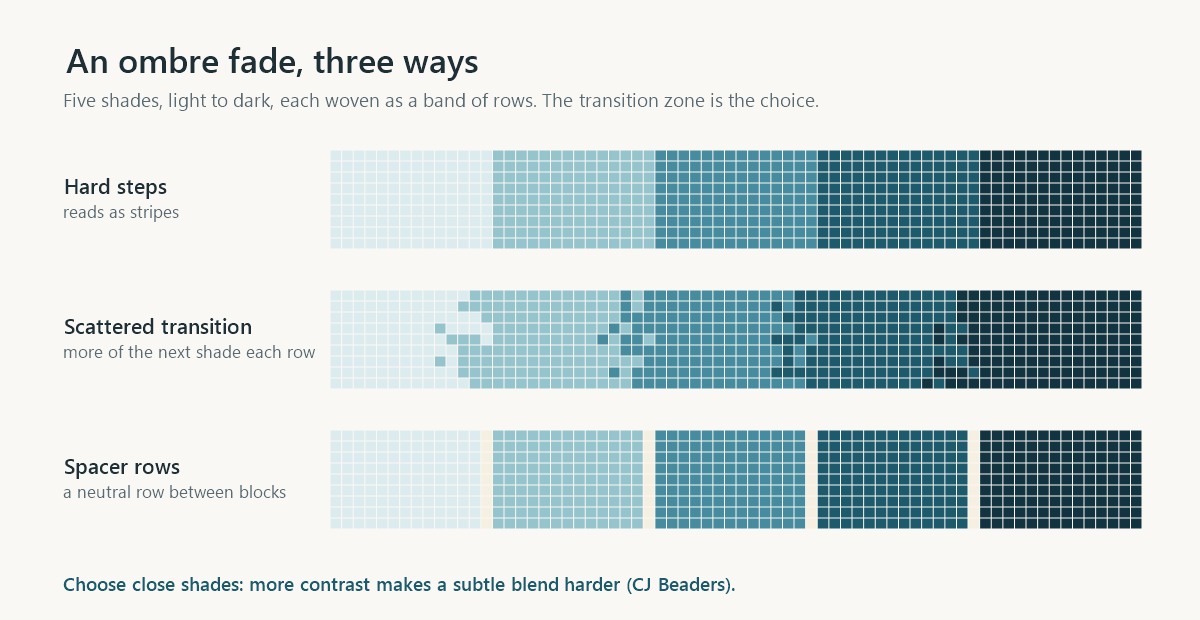
CJ Beaders adds three practical points:
- More contrast between colours makes a subtle blend harder.
- Miyuki tends to number a finish in sets, so consecutive numbers usually share a finish.
- Place transition beads randomly, for a speckled look.
On a loom you pick each bead from the chart, so chart the scatter rather than mixing piles. The number of shades sets the number of bands; plan a few transition rows between each pair. Erin has worked with far more:
With over 30 shades of grays, blacks (also including dark blues) and whites (which offer the reflective white of silver beads), I loomed this cuff 32 beads wide.
Erin Simonetti, Wrist Corsages
Planning a repeat
Count the rows in one repeat and fit whole repeats into the length, so the pattern does not stop halfway at the clasp.
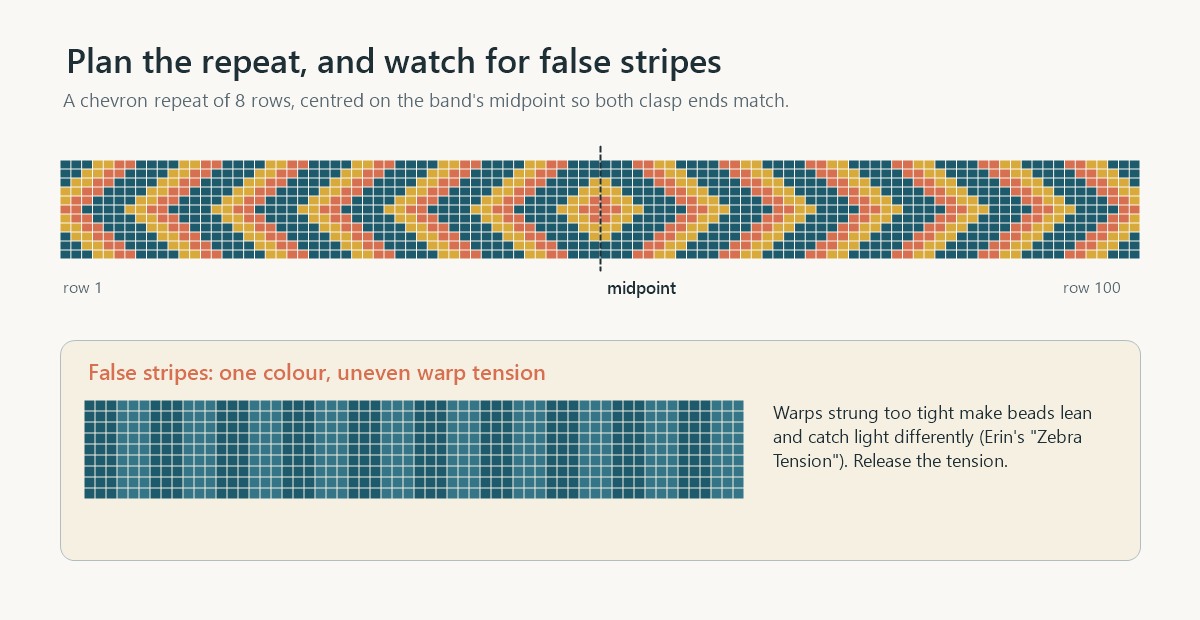
Centre the pattern on the band’s midpoint and work outward, and both ends will match. For row counts by wrist size, see the bracelet size chart.
False stripes
A one-colour band can show stripes you never charted. Erin calls this zebra tension:
This is what I call ‘Zebra Tension’. You notice the beads are ‘leaning’ from the tension, causing the light to play off the bead, differently, causing a ‘striped’ design.
Erin Simonetti, Techniques
Warps that are too tight cause it; see bead loom warp tension. Dark warp thread can also show between widely spaced beads as a stripe; see bead loom thread color.
Who owns a chevron?
Simple shapes are free to use. The US Copyright Office’s Circular 33 lists common patterns "such as standard chevron, polka dot, checkerboard, or houndstooth" as not protected. A larger design built from them can be, so a stranger’s full charted pattern still belongs to its designer. This is general information, not legal advice.
For more ideas, see bead loom bracelet ideas and Halloween bead loom designs.
Frequently asked questions
How do you make a chevron pattern on a bead loom?
Chart a V that steps one or more beads per row from a centre column, on bead-shaped cells. Use an odd width for a single-bead point.
Why do my diagonals look steeper than 45 degrees?
Loomed beads are taller than they are wide. A one-bead step climbs about 51 degrees with Delicas; step about five across per four rows for 45.
Should a geometric pattern be an odd or even number of beads wide?
Odd, if you want a single centre bead or point. Warps are the bead width plus one, so an odd width needs an even number of warps.
How many shades do I need for an ombre bracelet?
There is no fixed number. Each shade is a band; three to five shades with a few transition rows between each is a common start.
How do I blend colours smoothly in an ombre?
Choose close shades, then scatter beads of the next shade into the last rows of each band, a few more in each row.
Why does my one-colour band look striped?
Usually warps that are too tight, which make beads lean and catch light differently. A dark warp can also show as stripes.
Browse more Bead Loom Guides on the blog.