11/0 vs 8/0 Seed Beads: Which Size for Which Job

Seed bead sizes run backwards: the bigger the number, the smaller the bead. So an 8/0 is larger than an 11/0, and a 15/0 is smaller still.
This guide compares 11/0 and 8/0 beads side by side, then looks at their neighbors: 15/0, 10/0 and 6/0. It covers what each size does to a loom pattern, and how to mix sizes in one piece. It draws on bead makers’ measurements published by bead shops, and on the work of Erin Simonetti, the bead loom artist whose work this site shows.
11/0 vs 8/0 at a glance

| Feature | 11/0 | 8/0 |
|---|---|---|
| Diameter | 2.0 to 2.2 mm | about 3.0 mm |
| Hole | about 0.7 to 0.8 mm | about 0.9 to 1.2 mm |
| Strung beads per inch | about 17 to 20 | about 12 to 13.5 |
| Beads per gram (Miyuki) | about 110 | about 38 |
| Beading needle | size 10 to 12 | size 10, or any |
The figures come from Artbeads, Shipwreck Beads and Beadaholique. Brands differ a little: a Toho 11/0 measures about 2.2 mm, a Miyuki 11/0 about 2.0 mm.

Size and detail on a loom
On a loom, smaller beads mean more beads to the inch, and more beads mean finer detail. A curve, a letter or a face needs enough beads to show its shape. An 11/0 gives roughly twice as many beads in a square inch as an 8/0.
The same chart woven in a larger bead simply comes out larger. The drawing below uses Erin’s measured Delica count against the average for round 8/0 beads.
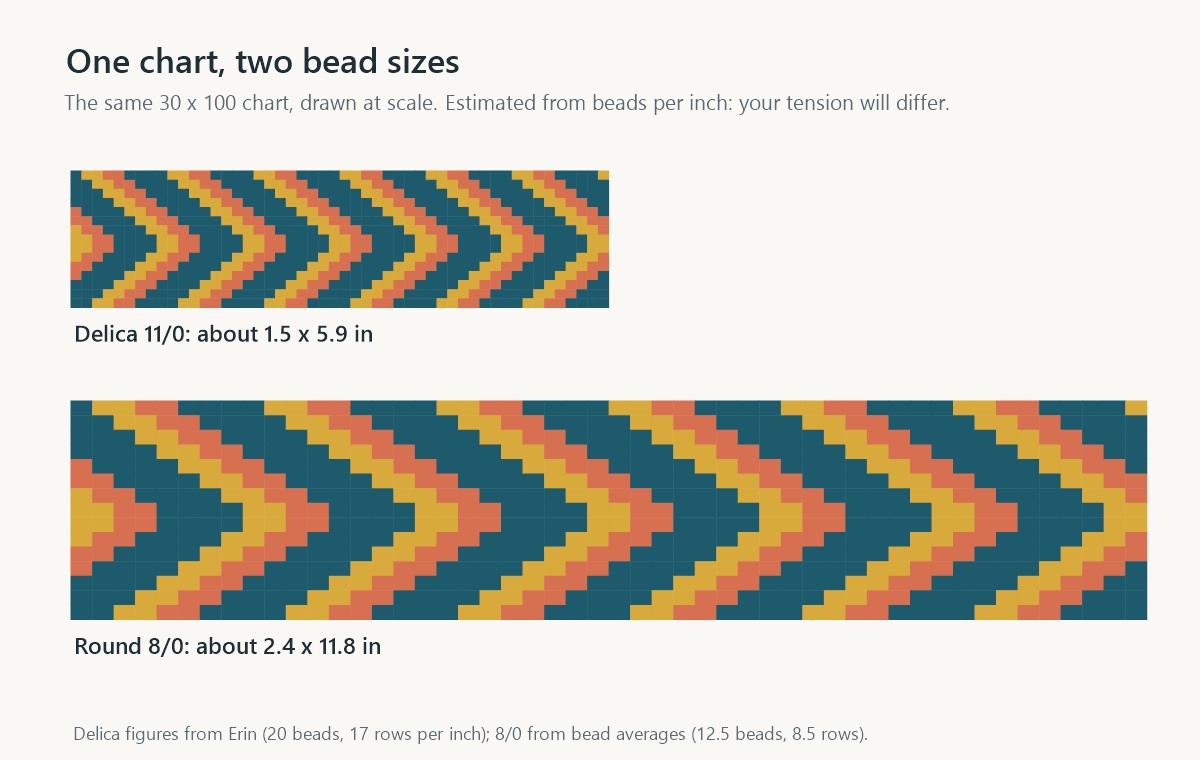
So check the size before you choose a pattern. A cuff chart meant for 11/0 Delicas becomes a long, wide band in 8/0 beads. To work out the finished size of any chart, use the bead loom calculator.
Holes and thread
The larger hole is the 8/0’s practical advantage. You can pass the needle through it more times, use a thicker thread, and string onto cord. Shipwreck Beads points out how fast an 11/0 fills up: three passes of size D Nymo is roughly 0.9 mm of thread, in a hole that might only be 0.8 mm.

On a loom, each bead usually takes two passes, one on the way through and one on the way back. An 11/0 handles that easily. Repairs and added embellishment are where a larger hole helps. For thread choices, see bead loom thread and needles.
When to choose 11/0
The 11/0 is the standard size for loom and bead weaving. Choose it for:
- detailed patterns, pictures, letters and portraits
- cuffs and bracelets of normal width
Erin weaves most of her cuffs in 11/0 Delicas, which are cylinder beads rather than round ones. For that difference, see seed bead sizes.
When to choose 8/0
Choose 8/0 beads for:
- bold, simple designs that need to read from a distance
- quick projects, since each row covers more
- accents, edges and fringe on 11/0 work
- pieces strung on thicker cord or leather
Mixing 11/0 and 8/0 in one piece
You don’t have to pick one size. Erin uses several sizes together for texture.
The silver fringe is also woven in a ‘layered’ design, using Toho Perm 8/0, 11/0 and mettalic silver 15/0 beads.
Erin Simonetti, Bead Layering
Then I added the Christmas Baubles, using 6/0, 8/0 and 11/0 silver lined glass beads.
Erin Simonetti, A Trimmed Tree Cuff!
Larger beads can also go into the weaving itself. Erin’s method is to measure first, then warp to suit.

The 4mm were equal to three of the 11/0. Again, just a bit of calculation, but not much.
Erin Simonetti, Weaving with Large and Small Beads
Since many options can be available to create a similar weaving, decide how many seed beads equal the large size bead width you are also weaving, before warping the loom.
Erin Simonetti, Weaving with Large and Small Beads
Even two kinds of 11/0 behave differently side by side.
Mixing the two different types of 11/0 beads together, in one weaving, makes for an interesting look. Be aware that you may either bulk out the larger beads, which create a nice texture to your bead work, or your edges may become wavy.
Erin Simonetti, What beads and why?
The neighbors: 15/0, 10/0 and 6/0
- 15/0 vs 11/0: a 15/0 is about 1.5 mm, with 25 to 28 beads per inch. It suits fine detail, edging and embroidery, and needs a size 12 or 13 needle.
- 10/0 vs 11/0: close in size. A 10/0 is about 2.3 mm, with 16 to 18 beads per inch. Mixing them in one row can make edges uneven.
- 6/0 vs 8/0: a 6/0 is about 4 mm, with 8 to 10 beads per inch. It suits stringing, accents and large-hole work.
For bead counts by weight, see how many seed beads per gram.
Frequently asked questions
Is 8/0 bigger than 11/0?
Yes. Seed bead sizes run backwards, so a higher number means a smaller bead. An 8/0 is about 3 mm across, an 11/0 about 2 mm.
What is the difference between 11/0 and 8/0 seed beads?
Size, hole and count. An 8/0 has a larger hole and weaves about 12 to 13 beads per inch, against 17 to 20 for an 11/0, so designs come out larger and less detailed.
Which size is best for a bead loom?
11/0 is the standard size for loom weaving and gives the finest detail. 8/0 suits bold, quick designs and accents.
Can you mix 11/0 and 8/0 beads on a loom?
Yes. Measure how many small beads equal the large bead’s width before you warp, and expect some texture or wavy edges where sizes meet.
What needle do I use for 8/0 and 11/0 beads?
A size 10 or 12 beading needle suits both. 15/0 beads need a size 12 or 13.
Will my pattern be bigger in 8/0 beads?
Yes, much bigger. A chart about 1.5 inches wide in Delica 11/0 beads comes out about 2.4 inches wide and twice as long in round 8/0 beads.
Browse more Bead Loom Guides on the blog.